
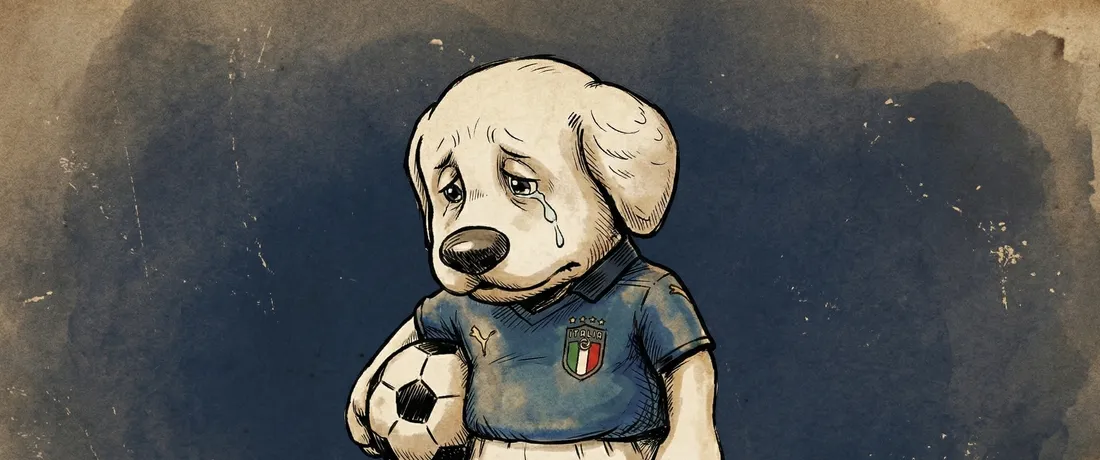
The Puppy Has Gone Home to Abruzzo
Following Italy's third consecutive failure to qualify for the World Cup, the Azzurri's Maremmano-Abruzzese Sheepdog mascot has returned to the mountains. His grandmother is not asking questions. She is just feeding him.
PESCARA, ABRUZZO — The puppy is home. He did not call ahead. He appeared at the door of his grandmother’s farmhouse in the hills above Pescara on the evening of April 1st, still wearing the Azzurri jersey, carrying nothing. His grandmother took one look at him and went to the kitchen. She has not mentioned football. She will not mention football. This is understood.
He has been there for three days.
The Ride Home
Sources close to the situation describe the puppy staring out the train window for the entire four-hour journey from Rome, watching the landscape change from city to coast to mountain. Other passengers recognized him. Nobody spoke to him. A man in the dining car bought him a coffee and set it down without making eye contact.
He drank the coffee. He continued staring out the window.
The mountains came into view somewhere past Chieti and he began to cry quietly, which a Maremmano-Abruzzese Sheepdog in an Azzurri jersey is allowed to do when those mountains appear, under these specific circumstances, after what he has been through.
What He Has Been Through
On the night of March 31st, Italy drew 1-1 with Bosnia and Herzegovina after ninety minutes of football that featured a red card, ten men, a goal conceded in the 79th minute, and, ultimately, a penalty shootout. Italy converted one of four penalties. Bosnia converted all four. The puppy stood at the edge of the pitch for the entire shootout, watching each kick with the specific expression of an animal that had been promised, repeatedly, that this time would be different.
It was not different. It was, if anything, more of the same, administered more efficiently.
This is the third consecutive World Cup Italy has failed to qualify for. The puppy has been present for all three.
Life in the Hills
His grandmother’s farmhouse sits on a hillside above a small town whose bar has a television that was tuned to RAI Sport for approximately eleven hours on the night of the match. Every person in the bar had a different explanation. Every explanation was delivered at full volume and involved extensive hand gestures. Two arguments broke out that were technically about the penalty kicks but were actually about things that happened in 2006 and possibly earlier.
The puppy is not going to the bar. The puppy is sitting on the stone wall behind the farmhouse, looking at the valley below, letting his grandmother’s chickens walk around him. He has been doing this for most of the day. It is not unpleasant. The Maremmano-Abruzzese Sheepdog was bred in these hills to guard flocks across this exact terrain, and something in his blood finds it quieting, which is what he needs right now.
His grandmother brings food to the wall every two hours. She does not ask how he is feeling. She can see how he is feeling. Instead she sets down the plate — pasta alla chitarra this afternoon, lamb last night, and this morning a breakfast that a doctor would describe as excessive and that the puppy needed badly — and she puts her hand briefly on his head and goes back inside. He eats everything. He is not okay but he is eating, which she considers progress.
The Confession
On the morning of April 2nd, the puppy went to the village church and sat in the confessional for forty minutes. Father Benedetto, who has served this parish for thirty-one years and has therefore sat through three Italian World Cup failures in this same confessional, did not hurry him. When the puppy eventually spoke, he asked whether it was a sin to have believed, again, despite all available evidence.
Father Benedetto said that belief was not a sin. He said that hope was not a sin. He said the sin, if there was one, was perhaps in the specific circumstances around the Bastoni red card. Then he caught himself and said that was not for him to judge. After a long silence, Benedetto continued “figliolo, neanche io capisco” — my son, I don’t understand it either — and the puppy found this unexpectedly comforting.
He has not returned to Rome. He is not ready to return to Rome. In Rome there are people with opinions and television cameras and federation officials who want to discuss the future, and the puppy does not want to discuss the future. The puppy wants to sit on the wall. He wants to eat what his grandmother brings him. He wants to watch the valley in the late afternoon light when the shadows come down from the mountains and everything gets briefly, mercifully quiet.
The Azzurri jersey is folded on the chair in the guest room. He has not put it back on.
He will. But not yet.